


The funding has been announced, and the ideas are starting to come in: a better playground, more trees, somewhere for neighbours to meet. Each suggestion reflects something people want for the place they call home. For your council, the next step is working out how residents can help turn those possibilities into a plan you can deliver.
That task is particularly pressing for councils supporting the 160 Phase 2 Neighbourhood Boards whose Pride in Place Plans are due by 30 November 2026.
The Pride in Place Programme offers up to £20 million per area over ten years, covering both capital and revenue spending. The separate Pride in Place Impact Fund provides up to £1.5 million for capital improvements, to be spent by March 2027. The four examples below draw on different funding programmes, but each offers a practical lesson for involving residents in neighbourhood investment.
Newham: build participation into a long-term process
The London Borough of Newham offers a useful starting point for councils planning sustained engagement. Its Community Assemblies programme began in 2018 and was renamed People Powered Places in 2023.
Across eight community neighbourhoods, residents propose local projects and vote on which should receive funding. The process combines online participation through Newham Co-create with in-person community assemblies.
Between 2021 and 2023, £1.6 million from the Neighbourhood Community Infrastructure Levy was invested in local ideas. Newham had funded over 300 resident-led projects since 2018, with 157 delivered in the 2021–23 cycle alone.
Newham Co-create, powered by Go Vocal, gives residents one place to follow the process: meeting minutes, videos, events and project timelines sit alongside polls, comments and participatory budgeting tools. Residents can use a budget simulator to prioritise projects within the available funding.
Recorded engagements rose from 3,147 in 2018–2020 to 16,552 in 2021–2023. These figures count interactions with the programme, rather than unique participants.
Newham Council also kept residents involved after the vote. Resident working groups helped oversee project delivery, giving the community a continuing role in the projects it had selected.
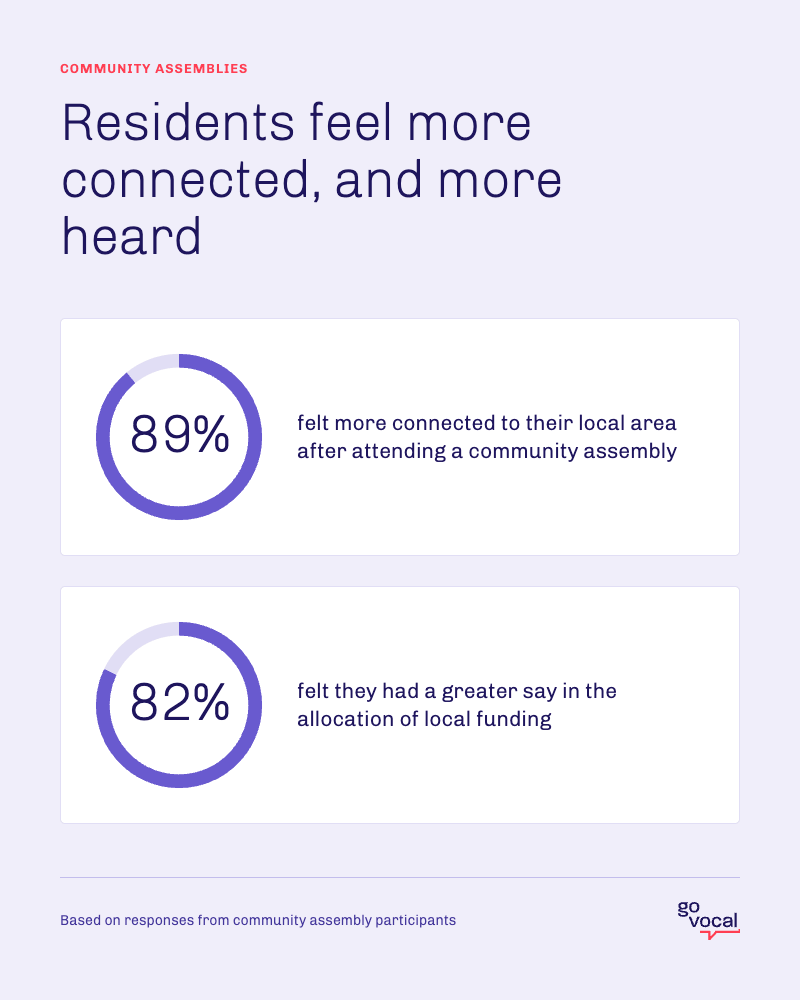
Feedback from participants involved in the programme in 2022/2023 was positive:
- 89% felt more connected to their local area after attending a community assembly.
- 82% felt they had a greater say in the allocation of local funding.
As Newham’s then Participatory Democracy Coordinator explained: “It is great to see the majority of residents have such a positive perception.” She also highlighted the increase in resident contributions, while acknowledging that participants did not yet fully reflect Newham’s diverse population.
The lesson
Plan for participation beyond the vote. Build in time for delivery, updates and evaluation, and keep checking whose voices are missing. For more on sustaining engagement throughout the year, read our budget-season engagement article.
THINC in Brixton and Peckham: make the choices clear
A public vote works best when residents understand the budget, eligibility criteria and decision they are being asked to make. The THINC Fund offers a useful example.
The £400,000 fund supports work to reduce health inequalities in Brixton, in Lambeth, and Peckham, in Southwark. It grew out of a partnership between Impact on Urban Health and Wellcome, with local community boards and ClearView Research shaping the approach.
Eligible residents, community groups and organisations could apply. The public vote was hosted on Southwark’s Go Vocal engagement platform. After 2,487 verified votes, 29 projects were selected to share the funding, with the results announced in December 2025.
Four features make the process easy to follow:
- A defined budget: residents know how much money is available.
- A defined scope: the criteria focus on health inequalities in the specified communities.
- Clear stages: a shared digital hub explains how to apply, when voting takes place and how decisions are made. A visible timeline helps residents understand what happens next.
- Specific, costed proposals: residents can compare projects and make a concrete choice about which to support.
The lesson
Agree and publish the rules before inviting applications. Clear eligibility checks and voting stages can reduce avoidable administration while giving residents a meaningful role in allocating funds.
Wigan: involve residents in the design
Wigan shows another way residents can influence investment. Its £1.5 million Pride in Place Impact Fund covers projects across Atherton North, Hindley, Worsley Mesnes, Wigan West and Ince. The council and local MPs identified the locations and projects; community engagement then helps shape the improvements.
In Hindley, children and families shared ideas for a new playground at the Salisbury Field Summer Fair. Wigan Council said their feedback would inform a design concept from playground company Wicksteed, which would then be shared with the community for further views. This is an example of residents shaping a planned project’s design.
The lesson
Be specific about the decision residents can influence. Even where a budget and site have already been agreed, there is still room for residents to shape what gets built and how it serves the people who use it.
Cambridge: turn local proposals into practical improvements
Cambridge’s Environmental Improvement Programme shows how local knowledge can inform smaller investments. In 2023, the council approved £169,000 for 47 projects proposed by residents, community groups and councillors.
The approved projects included seating and a wildflower area on Green End Road, a community garden and wildlife area on Peverel Road, and tree planting on Hobart Road. These were locally proposed improvements approved through the council’s decision-making process.
The lesson
Make it easy for residents to suggest specific improvements, then explain how proposals will be assessed and approved. Publish the outcome so people can see what happened to their ideas.
Put the right decisions in residents’ hands
These examples give residents different roles: proposing projects, voting on funding, shaping designs and following delivery. For Pride in Place, Neighbourhood Boards are the funding decision-makers, supported by councils and MPs, while the wider community helps shape local priorities.
Start by explaining the available budget, what it can fund and which decisions are open to resident influence. Share costs and constraints early so people can weigh the choices. Then show how their input affected the outcome.
A shared platform can bring proposals, timelines, voting and updates together, helping teams reduce duplicated administration. It works best alongside in-person engagement, with clear responsibility for reviewing proposals, reaching underrepresented residents and keeping people informed.
Pride in Place programmes already under way
Four councils have started their Pride in Place work, from recruiting a Neighbourhood Board to funding the first projects. Select a pin to see how each is involving residents.
Plan your Pride in Place engagement
For practical ideas on neighbourhood engagement, watch our webinar with professionals from Falkirk Council and the London Borough of Southwark.
Watch Pride in Place: Insights for Successful Neighbourhood Engagement.
Ready to map out your own approach? Book a chat with us to discuss how Go Vocal could support your neighbourhood funding process.



.jpg)