



Why trust between residents and governments matters
Trust is essential for the functioning and stability of a healthy democracy. It means that residents have positive expectations that their government and institutions will act competently, honestly, transparently, and with empathy.
In return, residents are more likely to participate, comply with rules, and support policies, leading to stronger, healthier communities that tackle challenges and support local needs.
Troublingly though, trust in government is experiencing a critical decline globally, as The Economist Intelligence Unit’s Democracy Index 2024 reports. Public trust is fundamental to effective governance – but it is fragile. In just a few seconds, a poorly explained policy, a misleading statement, or a failure to address public concerns can erode what took years to build.
Although trust is hard won and there is no single solution, data suggests that agency is a massive part of the answer.
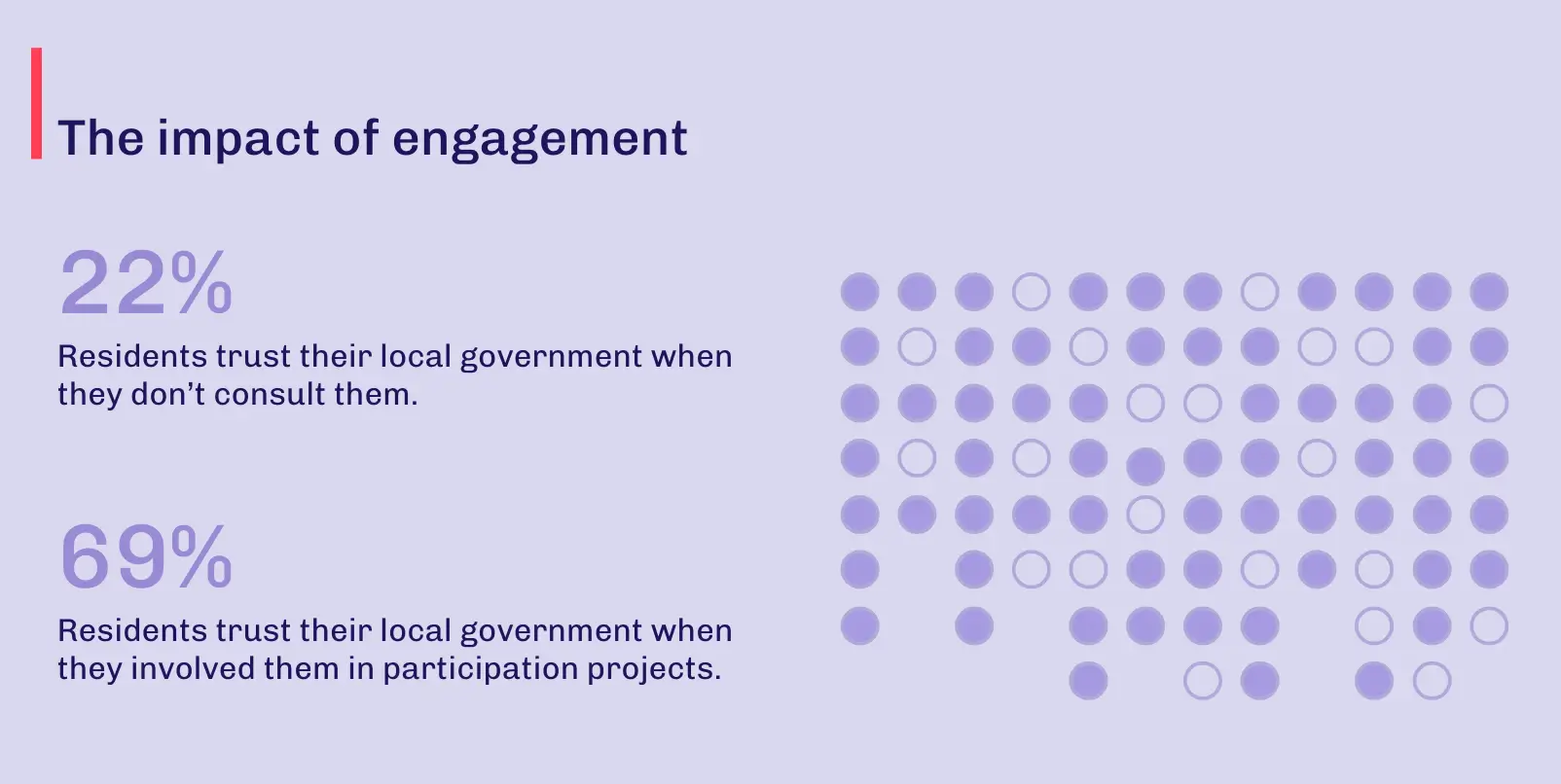
OECD data shows that getting a say in government actions is one of the most significant drivers of trust. In fact, 69% of individuals who feel they have a say trust their government, compared to only 22% among those who feel excluded.
This influence even outweighs socio-economic factors like financial security, education levels, or a feeling of belonging.
This provides a unique opening for local government. While higher-level policy often sets the framework, the local level is where those decisions actually come to life. It’s the arena where engagement is easiest to organise, and where residents can most tangibly feel that their voice is being heard.
Key strategies to build trust between residents and governments
Create transparent communication channels
Transparency means giving the public access to the decision-making process in easily digestible and jargon-free formats. This counteracts the perception that officials have ‘something to hide’ – a primary driver of skepticism.
Opening information to the public, and therefore to scrutiny, makes it easier for officials to be held to account, fostering a sense of fairness and equality.
Some practical, actionable ways governments can share information with residents are:
- Shout about it!: Publish budgets, spending, performance metrics, and decision-making processes in accessible formats. A multi-channel approach that mixes on and offline methods works for reaching diverse communities with marginalised groups.
- Ensure accessibility and inclusivity: Remove any potential barriers by implementing accessibility tools such as translations or text-to-speech software.
- Foster two-way communication and feedback: Create clear pathways for members to provide input, ask questions and give feedback. These could include online forums, surveys, or a dedicated phone line or email address.
- Go where the people are: Host in-person meetings, workshops, or pop-up events and information hubs at community spaces.
- Work with local organizations: Partner with trusted community, faith, and voluntary leaders and institutions to help disseminate messages and build relationships with underrepresented groups.
Involve residents in decision-making processes
Meaningfully involving the community in the decision-making process will make them feel like their voices matter.
Giving members an opportunity to shape the decisions that will affect their daily lives – like housing policy or changes to public spaces – will allow them to see how their input leads to tangible improvements. This reinforces that their contributions are valued and heard.
Try prioritising meaningful participation over token consultation by involving the community in a project from the get-go, as opposed to only doing so when major decisions have already been made. Then, design participation methods that are accessible to all demographic groups, ensuring under-heard voices are included.
These could manifest in multiple entry points – in person, and both on and offline – with plenty of opportunities for feedback baked in.
We’ve gone into more detail on how participation helps to rebuild trust within communities here.
Demonstrate accountability through action
It’s all very well telling the public that you’re reliable and accountable, but how do you show it? Practice what you preach by consistently following through on commitments to build long-term trust.
Close the feedback loop by communicating precisely how resident input has been used to influence a project’s direction, in ‘you said, we did’ summaries – or even regular ‘you said, we’re doing’ updates on projects that are still ongoing.
Post before-and-after photos of completed improvements in case studies, highlighting any details that were influenced by public input. Finally, address complaints and suggestions quickly and visibly, and if deadlines are set, make sure you stick to them.
Of course, we get it, mistakes happen and projects sometimes don’t go to plan. Governments are made up of human beings after all, and resources are often stretched thin. To hark back to an earlier point: this provides an opportunity for government transparency. Explain openly why, for example, you can’t implement a suggestion or are falling short on a goal, and it can actually increase public trust.
How digital tools enhance government-resident relationships
For a long time, participation outside of election times required the clearing of schedules and cancelling of plans to attend town hall meetings. This meant engagement was out of the question for those with unmovable commitments like shiftwork, caring responsibilities or children, to name just a few.
Today, governments can leverage technology strategically to increase reach by breaking down the barriers to engagement and supercharging efficiency.
Digital platforms can make participation accessible anytime, anywhere. And integrating digital with offline engagement methods will help reach diverse populations, capturing a far wider section of a community.
Technology also enables scale. Making sense of community feedback has always been one of the toughest, most time-consuming challenges in engagement work. Digital tools solve the reach problem, but by scaling participation to thousands of residents, they risk making that existing analysis bottleneck even tighter.
Platforms like Go Vocal streamline community engagement by centralising data collection, communication, and analysis in one accessible place, making it easier for governments to manage participation without burning through resources.
Built-in features – like clustering ideas, mapping input, and tracking engagement – are helping organizations quickly understand trends, while reporting tools and summaries make it easy to share insights with the public and demonstrate impact.
Moreover, these data and analytics tools are helping governments understand participation patterns to improve the quality of their outreach. This translates to higher levels of meaningful engagement which, eventually, boosts communities’ trust in government.
Measuring and maintaining trust over time
Trust in government cannot be built through one-off initiatives; it requires sustained, consistent effort. Here, measurement matters – by tracking trust levels over time, governments can ensure their engagement is consistent and effective. Key Performance Indicators (KPIs) to focus on when measuring trust are:
- Perceived fairness and integrity: Do community members feel decisions are made fairly and ethically?
- Perceived competence and reliability: Do community members believe the government has the ability to provide support in a timely and effective manner?
- Openness and transparency: Is information shared openly and in an accessible way, and are officials approachable?
- Two-way communication: Is the government perceived as listening to the community's needs and opinions when making decisions?
- Responsiveness: Are you demonstrating you're able to adapt strategies based on feedback and data?
This information can be collected using digital and physical forms and surveys. Discover a framework to help you collect data in a community engagement report here.
Start building trust today
Go Vocal helps you listen, analyze, and close the feedback loop — essential steps for earning and keeping public trust.
Curious how this looks in practice? Explore our platform features or book a chat with an expert to discuss your specific engagement challenges and see the platform in action.
FAQs on building trust between residents and governments


.jpg)