Community engagement in local government, from the mayor's seat
Danene Sorace spent 2017 knocking on doors across Lancaster, Pennsylvania, and the eight years after that as its mayor. In five short chapters she explains how community engagement in local government looks from the mayor's office, and what she needed from her engagement team before she could act on what residents told her.
If you run engagement, use this argument, made by a former mayor, to persuade your own mayor. If you hold office yourself, learn how quiet things became after she won.
From the Mayor's Seat: the full series · 10 min
Too often, engagement doesn't reach the mayor's office
Practitioners bring us this problem often: a survey closes and the findings go to a department head. By the time anything reaches the chief of staff, it's a summary of a summary. At our September live masterclass, two attendees described the same thing in the chat: their reports kept getting compressed until there was nothing left.
Danene's fix starts with the mayor's agenda. "The end is about delivering on your plans and your promises," she told the audience, "and building trust while you do it." Engagement earns time in the mayor's office when it helps deliver something the administration will be judged on. Each chapter below comes back to that.
About Danene Sorace
Danene Sorace was the 43rd Mayor of Lancaster, Pennsylvania. She took office in January 2018 after a year of campaigning door to door, and served two terms. She created the Office of Neighborhood Engagement, which City Council later made Lancaster's first new department in about 30 years. In 2020, when the city couldn't meet in person, she launched Engage Lancaster, which made Lancaster Go Vocal's first client in North America. She joined Go Vocal as a Senior Strategic Advisor in 2026.
Read the announcement →The five chapters
Each chapter answers one question. Below are its main points, plus what Danene added at her live masterclass on September 16, 2026. The full recording is in the Leadership Engagement Kit.
What do mayors miss without community engagement?
Most of the city. A mayor without a designed engagement process hears from whoever reaches the office, and Danene Sorace is blunt about who that is: people upset about something specific, and loud about it. Her early test was whether the same complaint arrived by letter, email and phone call. But as she put it, "most people don't call the mayor's office."
Takeaways
- Plenty of residents live with problems they shouldn't have to, and have stopped expecting City Hall to do anything about them. They don't show up in a mayor's inbox.
- Deliberate engagement reaches those residents while the decision is still open. The mayor still makes the call, with the whole city in view.
From the live masterclass
She describes the move from campaigning to governing as a paradox. Campaigning is "the most intense listening that you do," and in 2017 that meant thousands of doors, plus events full of people who aren't regular voters. Winning flipped it. "The amount of time and access to listening to the public inverts," she told the masterclass, and in her early days in office "it got really quiet." After that, what reached her depended on chance, such as who happened to stop her on the street.
The ones upset enough to reach you. The same ten, every time.
Reached on purpose, from across the whole city.
We asked the masterclass audience, most of them engagement practitioners, how they currently find out what their community thinks. The top answer was the engagement events they run. Second place went to whatever reaches their inbox or phone, the same channel Danene depended on before Lancaster had a system.
Why do elected officials hesitate to engage residents?
Asking the public feels risky to elected officials, since they're the ones who decide. Danene Sorace lists the fears plainly: residents will expect everything at once, loud voices will take over, projects will slow down, and some people will hate the outcome anyway. She had all four as mayor. Avoiding engagement, she argues, leaves every one of them in place.
Takeaways
- If you don't design how you listen, you mostly hear the loud voices, the people who already know how to reach a mayor. Designed engagement is what dilutes them.
- Say at the start what's fixed and what residents can still influence. That clarity heads off most of the expectations problem.
- Good engagement moves political risk earlier, to a point where you can still manage it.
From the live masterclass
The loud-voices fear came up live. One attendee, joining from Europe, described two critics who were dictating the agenda in their community. Danene's answer was more people: "The only way to dilute their voices is to get more voices."
On the fear of a decision people still dislike, she had a question of her own: "When is there ever consensus at 100%?"
How does community engagement help local leaders deliver?
Community engagement shows a mayor what a priority will take while there's still time to adjust it. For Danene Sorace, engagement is the means and delivery is the end. Lancaster had a lot to deliver: during her tenure it adopted its first comprehensive plan since 1993, alongside plans for Vision Zero, climate action, housing, mobility and green infrastructure.
Takeaways
- The biggest benefit is timing. Early listening works like a release valve: it shows you where the resistance is, and sometimes that what looks like opposition to a whole plan is aimed at one piece of it.
- The most useful thing an engagement team can give a mayor is a straight answer, uncomfortable parts included. A team that softens the feedback leaves the mayor with half the picture.
From the live masterclass
At the masterclass she walked through the plans Lancaster was running at once. "Each one of these plans is a promise," she said, "and how you're delivering on those promises is very important … to your electability in the future." When she asked attendees how many plans their own cities were running, the chat came back with more than 20, then 28. From Austin: "countless."
Listening late has a price. Engagement, she said, is what spares a project "everything from irate neighborhood meetings to … a potential lawsuit in the worst-case situation." And when a plan didn't change at all, the listening still paid off: "we did learn more and better ways to communicate about the change because we had listened."
Where should a mayor start with community engagement?
A mayor should start with one project that still has a real decision in it, and a clear reason for asking. Consulting residents on something already decided is the fastest way to kill engagement. Once that first project works, Danene Sorace's advice is to give engagement a permanent home in City Hall, so it outlasts the people who started it.
Takeaways
- Choose a first project where residents know something your staff doesn't, and where you can act on at least part of what you hear.
- When it's done, show residents what you heard and what changed. That record is your case for the next project.
- Give engagement an owner, so everyone in City Hall knows where input goes and who has to act on it.
From the live masterclass
Her own street taught her what a consultation looks like when the decision is already made. The city proposed a bike lane ("always a bike lane," she said) and held a meeting about it at a nearby church. A few weeks later, a line was painted on the street. The read in the neighborhood was that "the city was going to do what the city was going to do."
In office, she changed the structure before choosing any tools. She set up an Office of Neighborhood Engagement, an idea she says she "blatantly stole" from a New Orleans job description, and City Council later made it a permanent department. Weekly office hours and a quarterly whiteboard session kept it running.
Planning the strategy itself? Our guide to the six elements of a community engagement strategy covers what goes into one.
How should you measure community engagement?
Start with who you heard from and who you didn't. As mayor, Danene Sorace always wanted the participation numbers, but a report only helped her if it also showed who was missing and where residents disagreed. She'd take 150 people who reflect the city over a bigger crowd that includes people who don't live there.
Takeaways
- Tell your mayor whether the engagement changed anything. Sometimes the only change is in how a decision gets explained, and that counts too.
- Close the loop with residents: say what their input changed, and where you went a different way and why.
From the live masterclass
What Danene wanted in an engagement report
- The participation numbers, and who was missing from them
- Where residents agreed, and where they didn't
- Legitimate concerns, even when only a few people raised them. "Parking is often an issue."
- Resident quotes she could use in her remarks
What she didn't want was a report calling a project "overwhelmingly" popular while it glossed over the one or two concerns that mattered, like safety or lighting.
Who's missing usually comes down to distribution. Lancaster's first quality-of-life survey "failed … pretty miserably," she said, because it reached a narrow set of residents. Her lesson was to put the ask where people already are: every city email, every event, and doors in the hardest-to-reach neighborhoods, in Spanish wherever it's the primary language. About 40% of Lancaster's residents speak Spanish, according to our Lancaster case study.
Danene's five first steps
She closed her part of the masterclass with these.
Start with the plan, not the platform.
Tie engagement to the plans your administration will be judged on.
Decide why you're engaging before you engage.
Her test is whether you're asking for feedback you can act on. Sharing information is a different job.
Pick one project with a real decision still in it.
Do it well and residents learn where their input counts. In her words, they start to think "this is where I get to weigh in."
Put the report on a calendar, not on a person.
Book engagement reports into the council calendar, and build engagement into the reports already headed there. Her example was street trees: nobody plants one in front of someone's house without talking to the neighbors first.
Ask who didn't answer.
Then go find them.
Making the case to your own mayor
Most of the masterclass audience worked in engagement, so the Q&A turned to managing up. The whole Q&A is in the kit.
How do you get a mayor excited about engagement?
Show them how much weight it takes off. On a complicated or controversial project, one person can't take in all the feedback. A designed process gave residents somewhere to go other than Danene, and meant she was no longer "always being the target of feedback."
What if engagement pushes against a decision leadership wanted to keep?
Your job is to carry the feedback in and report back out, hard news included. Pass only good news up the chain, Danene warned, and people inside City Hall stop trusting that you're telling them everything. Agree on what she called "rules for the road" before the project starts. The worst spot, she said, is a decision made over your head that leaves you nothing to tell the community.
What should reach the mayor's office between reports?
Good news, first. Most of what reaches a mayor is complaints, and "good news is … gold sometimes." Danene also wanted a heads-up before community meetings: who was likely to show up, and what they'd want to raise.
What if my mayor supports engagement in public but not in practice?
Danene called it "the worst" position for a practitioner. Her advice is to frame it as the mayor's problem, because it is one. When engagement visibly changes nothing, people stop showing up and trust erodes. In her view, that ends up undermining the mayor's own authority. "That is the message that you have to find a way to deliver back," she said. "And I know it's not easy."
Want your mayor to see this? Email them this page
Get the Leadership Engagement Kit
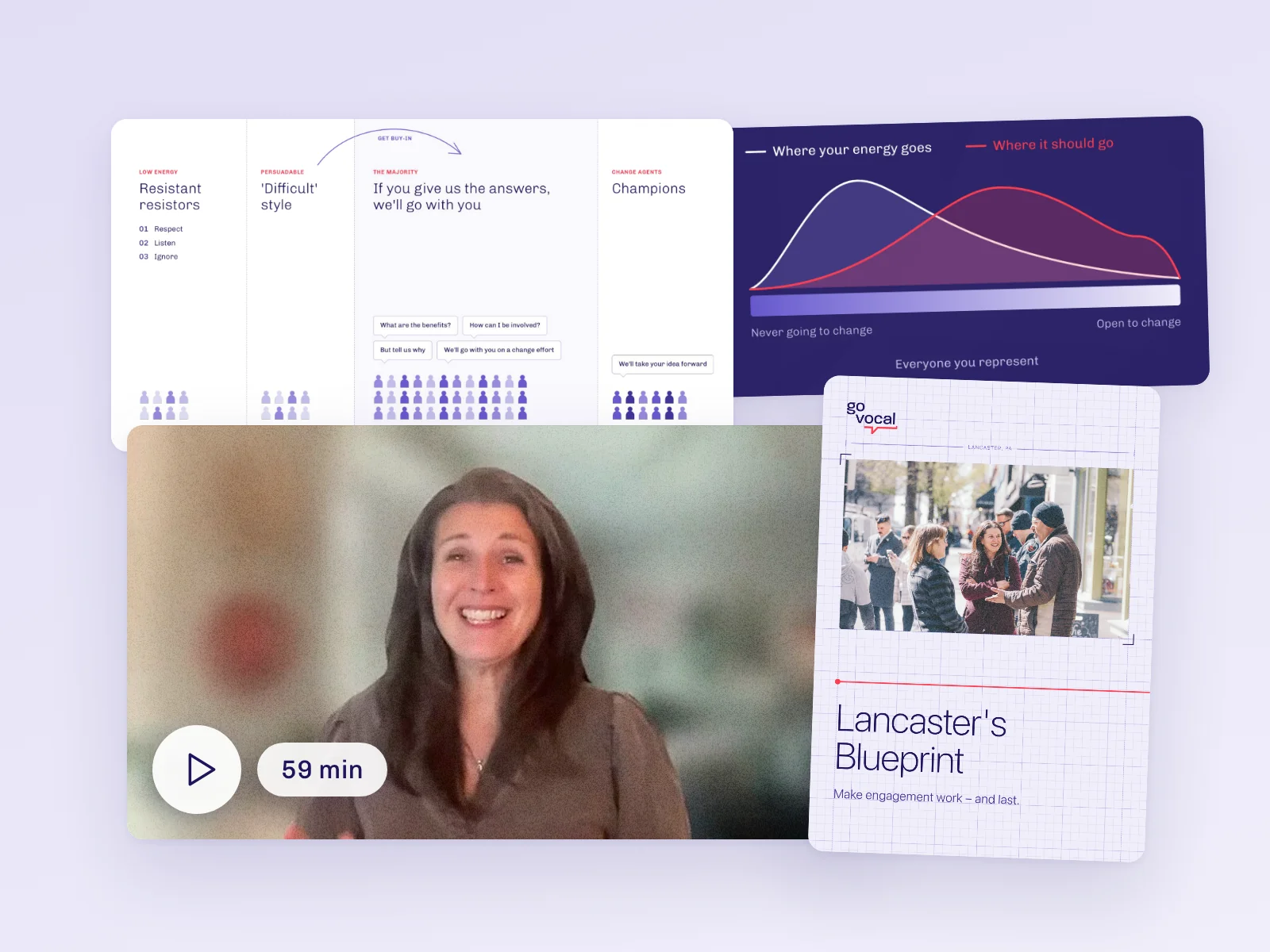
The series is the short version. The kit has the full hour Danene spent with mayors and practitioners on September 16, 2026, and everything she showed them.
The full masterclass recording
59 minutes with Danene and Go Vocal CEO Wietse Van Ransbeeck, plus the audience Q&A.
The masterclass slides
The deck she presented, from the five stages of her two terms to the map of Lancaster's plans.
Lancaster's Blueprint, our playbook
How Lancaster built engagement into city government, in five steps from the mayor's first commitment to a funded department. Each step lists actions for leaders and for staff, and the last pages cover keeping the work going when leadership changes.
Where should we send it?
Vereinbaren Sie ein Produktgespräch mit mit einem unserer Expert*innen

In nur 20 Minuten erfahren Sie, wie Sie schwer erreichbare Einwohner*innen einbeziehen, bessere Rückmeldungen sammeln und fundiertere Entscheidungen treffen können – alles über eine KI-gestützte Plattform.
.svg)